Rafael Rozenlum: From Pharma to Digital Transformation
A Conversation with UCLA-NUS EMBA Alumnus Rafael Rozenblum in the UAE: Rafael Rozenlum on successfully navigating relocations and pivoting functions
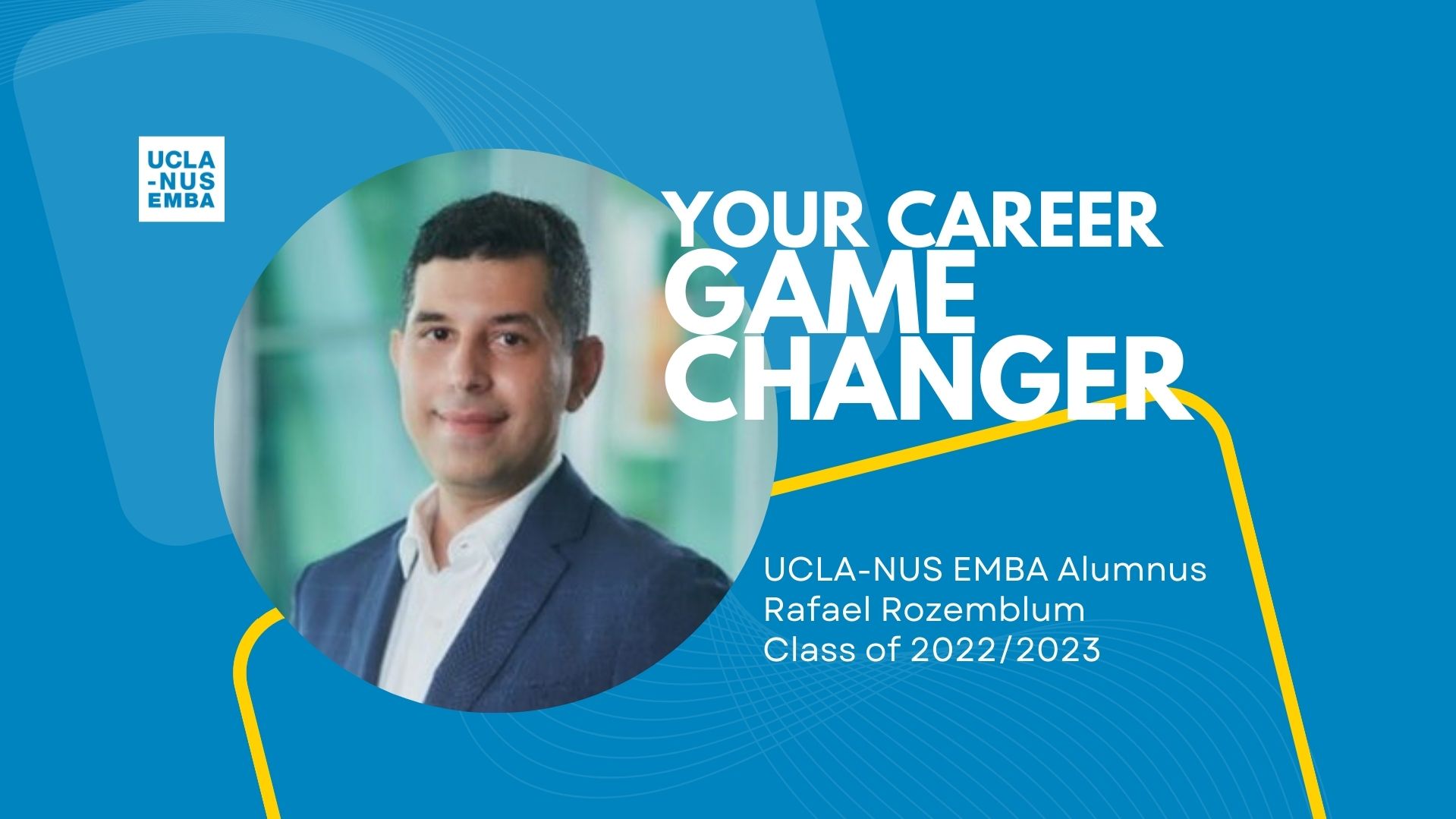
Based in Dubai and originally from Brazil, Rafael Rozenblum has spent more than two decades in the global pharmaceutical and healthcare industry. Today he leads data, digital, and technology initiatives across Eurasia, the Middle East, and Africa. His career has taken him from Brazil to the Middle East to Singapore and back to the UAE. In this interview, Rafael shares how the UCLA-NUS Executive MBA broadened his perspective, supported his career pivot into digital transformation, and why he believes the program holds particular value for professionals in South America and the Middle East.
Could you start by introducing yourself and your professional background?
I have more than 20 years of experience in the pharmaceutical and healthcare sector, focusing on business operations and corporate strategy. I began my career in Brazil in local roles that gave me a strong foundation in the market.
My first international assignment brought me to Dubai, where I led the Middle East and Africa region from a business insights and data analytics perspective. Later, I moved to Singapore to spearhead customer excellence and customer experience initiatives across emerging markets. That role covered Asia Pacific, Latin America, and the Middle East and Africa, which gave me broad exposure to the dynamics of fast growing regions.
After five years in Singapore, and following my EMBA, I shifted toward digital transformation. Much of my work in customer experience was already tied to digital enablement, and it felt like a natural transition. I returned to Dubai to lead data, digital, and technology for the regions of Eurasia, the Middle East, and Africa.
Why did you choose an Executive MBA instead of shorter executive courses?
I wanted to expand the breadth of my experience.
Short programs can be valuable, but I wanted deeper interaction with professionals from many industries. The UCLA-NUS EMBA offers exactly that. It brings together faculty from the United States and Asia and classmates who work in many parts of the world. We often looked at the same issue through very different lenses, shaped by our markets and industries. That level of diversity is hard to find in a local program.
I also wanted to learn from peers. Many classmates were senior leaders who had already built long careers. Hearing how they approached opportunities and challenges added tremendous value to the learning experience. Diversity, breadth, and peer learning were the reasons I pursued an EMBA, and the program delivered on all three.
How does the UCLA-NUS EMBA benefit professionals in South America and the Middle East?
For professionals in South America, the program offers a combination that is rare. South American markets have long been influenced by the United States, so earning an EMBA from a top American university is a major advantage. At the same time, Asia is growing rapidly and faces challenges comparable to those in South America. Exposure to Asian markets and their approaches provides insights that are directly applicable to emerging economies.
You essentially gain the benefit of a highly recognized American degree and deep understanding of Asian and emerging market dynamics. This combination is uniquely relevant for South American professionals.
For those in the Middle East, the advantages are equally strong. The UAE is a meeting point of East and West and is undergoing significant economic transformation. The region is attracting top talent from around the world and diversifying beyond oil. To succeed here, you need cross cultural sensitivity, adaptability, and comfort working with globally diverse teams.
The UCLA-NUS EMBA gives you that preparation. You study with people who live and work in very different markets and learn how to navigate those environments in a safe and supportive setting. This is directly relevant to the real-world nature of work in the UAE and Saudi Arabia.
What was your experience in the program like? What were your favorite aspects?
My EMBA experience was both fulfilling and challenging. Many of us were balancing demanding professional roles, personal responsibilities, and in some cases, family commitments. The structure of the program helped because the intensive module format allowed us to focus completely on coursework during specific weeks.
Some of my favorite aspects were the following.
Class interactions
The classroom was filled with people from industries such as technology, finance, government, and manufacturing. This created rich discussions and exposed me to ways of thinking I had not encountered before.
Company and industry visits
The program’s network allowed us to visit organizations that are leaders in their fields. Seeing these environments firsthand and engaging with senior executives gave us insights that go far beyond what can be learned in a case study.
Community and connection
We learned hard, but we also enjoyed the time we spent together. Exploring cities, sharing meals, and building friendships made the experience memorable. Our class remains close, and when I moved from Singapore to Dubai, the alumni network here played a meaningful role in helping me settle in.
These relationships continue to be one of the biggest takeaways from the program.
How did the EMBA influence your move into digital transformation?
The EMBA helped me gain the confidence to shift into a new field.
My background was in customer experience and corporate strategy, so digital transformation required a different set of skills. The program did not teach me everything about digital, but it taught me how to learn quickly and operate in unfamiliar territory.
A key moment was the capstone project. Our team worked with Santa Monica City Hall to explore how they could expand digital services for citizens. It was a sector I knew nothing about. After several months of research and collaboration, we delivered meaningful recommendations. This project showed me that I could enter a new domain, learn rapidly, and add value. That experience was crucial in helping me decide to move into digital transformation.
What makes the UCLA-NUS EMBA different from programs available locally in the UAE?
One of the most important differentiators is the truly global nature of the program.
Students earn two degrees from two top universities, one in the United States and one in Asia. Both have strong reputations and large alumni networks, which means you can find support in many countries around the world.
Just as important is the global structure of the program. You study in several locations, visit companies across industries, and learn alongside classmates who are based in very different markets. Many local programs offer diversity in the classroom, but most participants live in the same country. In the UCLA NUS EMBA, classmates live and work in South America, North America, Europe, Asia, and the Middle East. They bring live insights into what is happening in their markets.
This gives the program a level of global immersion that is hard to replicate in a domestic setting.
What advice do you have for prospective students?
My advice is simple. Take the step.
People often spend a long time comparing programs and asking whether they can manage the workload. From my experience, once you reach the end of the fifteen months, you realize that you were able to do it and that the learning you gained is incredibly valuable.
The program accelerates your career and your personal development. The pace is intense, but the growth is tremendous. If you are seriously considering the program, my recommendation is to move forward. The benefits will be significant.
Connect with the admissions team today!
Click here to learn more about the UCLA-NUS EMBA program and why it is the program designed for global leaders.
Alternatively, click here to schedule a 1-on-1 Zoom call with our admissions staff.